Malika Ammam, PhD
Consultant - Freelancer

A Better Way to Learn Redox Chemistry Part 1: Summarized Principles and Over 250 Answered Questions and Problems
This short book (part 1) summarizes some basics of redox chemistry (electrochemistry) in solution. Each section of the book contains concise and clear referenced summaries of redox concepts. Over 250 answered questions and problems are provided to further clarify the discussed principles.
Mini Mixer
Mini Mixer

Some Basics of Chemistry
Useful in Redox Processes
A better understanding of redox (or electrochemical) processes in solution requires the
knowledge of some basics related to chemistry. These include, what solvents and electrolytes are
used in redox chemistry, the influence of parameters like conductivity, acidity, basicity, pH, and
some thermodynamics and kinetics associated with these processes. This Section 1 summarizes
some of these basics. Remember that all redox are chemical processes but not all chemical
reactions are redox and only those involving the transfer of electrons are characterized as redox.
Mini Mixer

Electrons in Matter and Link
to Redox Chemistry
Keep in mind that redox reactions are chemical processes but not all chemical reactions are redox.
Redox chemistry, also known as electrochemistry, involves the loss or gain of electrons and could track
the movement of consumed or released electrons during the process. Electrons are believed to exist since the early stages of formation of the Universe during the Big Bang. These subatomic particles, called electrons, are part of atoms, molecules, and matter in general. To better understand electrochemical processes discussed in later sections, some basics related to electrons are given here, including the structure of atoms, periodic table, main electronic models, electronic configuration, and the energy levels of electrons.

Principles of Redox Reactions
After reading Section 2, students should be able to identify the electronic structure of any
element of the periodic table and be able to visualize the electrons of the outer shell, which could
be involved in redox processes. This section 3 summarizes the basics of redox (or
electrochemical) processes by focusing on the species that might lose or gain electrons,
determination of the oxidation numbers (or states) of atoms in species involved in redox
processes, and easy ways of balancing redox reactions.

The previous section provided a short concise definition of redox reactions and proposed
ways to determine the oxidation states of elements, as well as how to balance redox reactions.
This section discusses the importance of reference systems (or electrodes) in electrochemistry for
determining the potentials of redox reactions at conditions different from the standard. The
variation trends of redox potentials across the periodic table are also summarized.
After highlighting the importance of reference systems (or electrodes) in the
determination of redox potentials (Section 4), further details regarding their measurements are
given in this section. These include the cell composition in terms of electrode and electrolyte and
the main mathematical quantities governing the redox reactions at equilibrium states.
Reference Systems and
Electrochemical Cells

Applications of Nernst
Equation
Redox equilibria are previously explained by the Nernst equation (Section 5), which
could be applied in many electrochemical systems to estimate quantities, such as potentials and
concentrations of redox species in solution. This section 6 is devoted to applications of the
Nernst equation in electrochemical systems, including energy (consumption or generation),
corrosion, redox titration, as well as study of solubility, precipitation, and complexation
reactions.

Une Meilleure Façon d'Apprendre
l’Oxydoréduction Partie 1: Résumés des Principes et Plus de 250 Questions et Problèmes Résolus
Ce petit livre (Partie 1) résume quelques principes de chimie d’oxydoréduction (électrochimie) en solution. Chaque section du livre contient des résumés référencés, concis et clairs des concepts d’oxydoréduction. Plus de 250 questions et problèmes avec solution sont fournis afin de clarifier davantage les principes discutés.
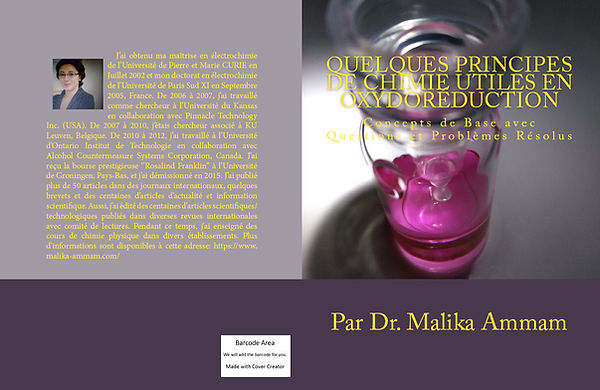
Quelques Principes de Chimie Utiles en Oxydoréduction
Une meilleure compréhension des processus d’oxydoréduction (ou électrochimiques) en solution nécessite la connaissance de quelques notions de base liées à la chimie générale. Ceux-ci comprennent, les solvants et électrolytes utilisés en chimie d’oxydoréduction, l'influence de paramètres tels que la conductivité, l'acidité, la basicité ou le pH, ainsi que les thermodynamiques et cinétiques de ces processus. Cette section résume certaines de ces bases. Rappelez-vous que tous les processus d’oxydoréduction sont des processus chimiques, mais pas toutes les réactions chimiques sont redox et seules celles impliquant le transfert d'électrons sont caractérisées comme redox.
Électrons dans la Matière et Lien avec l’Oxydoréduction

Il faut garder à l'esprit que toutes les réactions d'oxydoréduction sont des processus chimiques, mais pas toutes les réactions chimiques sont redox. L’oxydoréduction, également connue sous le nom d'électrochimie, implique la perte ou gain d'électrons, et également peut suivre le mouvement d’électrons consommés ou libérés au cours de processus. Les électrons existent depuis les premiers stades de la formation de l'Univers pendant le Big Bang. Ces particules subatomiques, appelées électrons, font partie des atomes, des molécules et de la matière en général. Pour mieux comprendre les processus électrochimiques, certaines notions de base concernant les électrons sont discutées dans cette section, y compris la structure des atomes, le tableau périodique, les principaux modèles électroniques, la configuration électronique et les niveaux d'énergie des électrons.

Principes des Réactions d’Oxydoréduction
À ce stade, les élèves devraient être capables d'identifier la structure électronique de n'importe quel élément et d'être en mesure de visualiser les électrons de la couche externe, qui pourraient être impliqués dans des processus d’oxydoréduction. Cette section résume les principes des processus d’oxydoréduction (ou électrochimiques) en se concentrant sur les espèces qui pourraient perdre ou gagner des électrons, détermination des nombres (ou états) d'oxydation des espèces impliquées dans ces processus redox et les moyens faciles d'équilibrer des réactions d’oxydoréduction.

Systèmes de Déférences et Cellules Électrochimiques
La section précédente décrivait les réactions d'oxydoréduction et proposait des moyens de déterminer les états d'oxydation des éléments, ainsi que les moyens d’équilibrer les réactions d'oxydoréduction. Cette section discute l'importance des systèmes de références (ou électrodes) en électrochimie en détermination des potentiels des réactions redox aux conditions différentes des standards. Les tendances des potentiels redox à travers le tableau périodique sont également résumées.
Après avoir souligné l'importance des systèmes de références (ou électrodes) pour déterminer les potentiels d'oxydo-réduction, d'autres détails concernant leurs mesures sont donnés dans cette section. Ceux-ci comprennent la composition des cellules électrochimiques en termes d'électrode et électrolyte, ainsi que les principales quantités mathématiques régissant les réactions redox à l'état d'équilibre.

Applications de l’Équation de
Nernst
Les équilibres redox sont expliqués précédemment par l'équation de Nernst, qui pourrait être
appliquée dans de nombreux systèmes électrochimiques pour estimer ses quantités, telles que les
potentiels et concentrations des espèces redox en solution. Cette section est consacrée aux
applications de l'équation de Nernst dans les systèmes électrochimiques, y compris les cellules
énergétiques (consommation ou génération), corrosion, titrages redox, ainsi que l'étude des
réactions de solubilité, précipitation et complexation.

Is Our Universe Expanding to Form Something?: The Polymerizing Universe Hypothesis
Our current telescopes can perceive the Universe with only an oval shape. What if there is more? This short note proposes that the Universe is polymerizing to form something at the end of the process. It is written in a simplified language that can be understood by nonscientists and the general public.

Could Current Science Explain Paranormal Phenomena?: Introduction to Concepts of ''Broadcast-Reception'' and ''Broadcast-Storage-Retrieval'' of Information and Energy via the ''Human Wireless Senses''
One way or another, you likely heard the terms ''paranormal'', ''supernatural'' or ''sixth sense'', whether through the longest-running science fiction series ''The X-Files'' or the 1999 American supernatural horror film ''The Six Sense''. These interchangeable terms, oftentimes referred to as paranormal, encompass phenomena that could not be ...

Is Frequency the Carrier of Consciousness, and is the Ultimate Goal of Universe to Grow Consciousness?: Introduction to Consciousness Wave Force
Have you ever felt as if your life is held in balance by an unknown force that you could not describe or comprehend? You can not see it, hear it, taste it, smell it or touch it, but it is there influencing every moment of your life from birth to death. The underlying complexity of human perception goes often overlooked but by reaching higher consciousness, one could realize the true value of our existence. But what exactly is consciousness? When did start and how did it evolve? ...

In the Question of Purpose: What would it take for Humanity to Become a LAW in the Universe, and is it on the Right Track?: From Chaos and Inconsistency to Order and Predictability through Death as Balancing Force
The universe is vast and unexplored, and explicit answers are rare, leaving some of us wondering what is it all about. Despite the hurly-burly of everyday life, you have probably wondered, at least once in a while, about the meaning of life whether on your own or collectively. Some think that life is intended to realize one's potential and ideal, while others believe that life is meant to do good and right through love and enjoyment of living. Other interpretations of the purpose of life include the quest for wisdom and knowledge, achieving biological perfection through immortality, and search for power. But is there a more profound and fundamental answer to what is it all about? In this essay, ...

Free will, destiny/fate, and soul: Are these concepts pure human fantasies or misunderstood reality, and is death the end or only the beginning?: From non-harmonic to harmonic waveforms through mirroring of consciousness information by BALANCE force
In life and death, everyone enters with specific performance and exits with an ambiguous enchantment. Most of us view life as of little use that should be lived to the fullest because the undermined death challenges us not to waste it. But is death the end, or only one stage of a long learning process to deliver an elegant performance, a perfectly fitting end? The concept of life after death goes back to ancient times with notions stretching from destiny/fate to freewill/punishment and soul. But are these ancient beliefs, which later became parts of religious doctrines, pure human fantasies, or misunderstood reality?
In this essay, I analyzed a human life as a particle-wave ...

Deities and Gods: What are they and what for? Are they truthful and eternal or corrupt and mortal, and how balance could fix the problem: Link between the corrupt nature of species, evolution, formation of patterns, math equations, aging, and death
Life is a question, death is a mystery, and in between, there are Deities and Gods to explain it all. From the earlier times and roots of all religions, humans tend to address various Deities and Gods based on the culture of language and tradition, grasping into the belief of the truth to unconditionally share their worries and desires with something they believed in. When problems emerge, prayer is a valid answer for an unexplainable relief, heavenly healing that anyone can receive. The concept of Deities ...

Is there Good and EVIL and Right and Wrong in a human system driven by DRUGS, and how does balance turn drug addiction into reason and zeroed math equations?: Is zero nothing or EVERYTHING?
There are two sides to every story until there is only one. The story of mankind is the story of lies and deceit to self and others. Humans tend to look at life's equation from a very limited perspective with good and evil as two separate sides of the story. But isn't it human nature to play with evil?In this essay, I attempted to answer whether there is a universal and transcendent definition of good and evil because these notions impact the universal principles dictating right and wrong and how people should act in any situation ...

Is TIME the creator of CONSCIOUSNESS out of the destruction of SPACE by drug addict species, and is life the artwork of God or the DEVIL?: Link between space, drug craving, self-assembly, accelerated destruction, death, consciousness, and time
There is something mysterious about nature, with the sun and the moon turning in cycles, seasons coming and going, the human body aging, and death as the ultimate end and beginning to balance them all. These manifestations have something in common, an essence that most of us do not understand and mysteriously refer to as TIME. To unfold the mystery of time, one must go back to the beginning when all started, work its way through evolution, and accept the dirty reality as is, without twisting it into a beautiful lie to fulfil a happy life.
The concept of time ...